Author: Trisha Faulkner

  • Here’s What $200 Gets You at Kroger This Week (Sept 30–Oct 6)

    Here’s What $200 Gets You at Kroger This Week (Sept 30–Oct 6)

    New ad week, new math. Kroger’s fresh weekly ad dropped this morning — Wednesday, September 30 — and runs through Tuesday, October 6. I went through the whole ad plus the digital coupons so you don’t have to, and built a real family grocery cart that lands at $199.94. Breakfasts, lunches, dinners, snacks, and actual food your family will eat. Not vibes. Food.

    Quick note before we get into it: Kroger sales and digital coupons can be location-based, so your prices might be a little different from mine. This week’s numbers are from my store. The list should still give you a solid starting point wherever you are.

    One more thing: Kroger’s site has a banner up today warning they’re “currently experiencing intermittent problems with Digital coupons.” Half this cart needs a coupon clipped before you shop, so screenshot every coupon on your phone and check the receipt before you leave the store. Don’t let a glitchy app f*ck up your total. I already had a few of these clipped on my account, which made it easier.

    Also: there’s a 4X fuel points offer running this whole week (Sept 30–Oct 6, I had it clipped already), and this cart is heavy on groceries, so you’re basically getting paid in gas money. Pocket Change Mama loves a double-dip.

    Kroger weekly deals grocery haul for under $200, September 30 to October 6

    🥬 Produce — $27.54

    • Jumbo Blueberries — $4.99 × 1 = $4.99
    • Kroger Seedless Grapes (red, green, black, or tri-color) — $4.99 × 1 = $4.99
    • Honeycrisp Apples — $1.99/lb × ~2 lb = $3.98
    • Green Bell Peppers — 89¢ each × 4 = $3.56
    • Roma Tomatoes — $1.29/lb × ~2 lb = $2.58
    • Sweet Corn — 33¢ each × 6 = $1.98
    • Cilantro — 99¢ × 1 = $0.99
    • California Pomegranate — $2.49 each × 1 = $2.49
    • Kroger Baby Carrots, 16 oz — 99¢ with digital deal × 2 = $1.98

    Thirty-three-cent corn and 89-cent peppers are doing the quiet work here. The flashy boxes get the clicks; the cheap produce gets the savings.

    🥩 Meat — $58.43

    • Fresh Tyson Chicken (full line sale) — Buy 1 Get 1 FREE: one family pack of boneless chicken breasts ~$9.99, second pack free = $9.99
    • Boneless Chuck Roast (USDA Choice) — $6.99/lb (was $27.05 on the featured roast) × ~2.5 lb = $17.48
    • Smithfield Bacon — $3.99 × 2 = $7.98
    • Kroger 80% Lean Ground Beef Patties — $12 × 1 = $12.00
    • Kroger Beef Bacon — $5.99 with digital deal × 1 = $5.99
    • Perdue Frozen Chicken — $4.99 × 1 = $4.99

    That Tyson buy-one-get-one is the single best meat deal in the whole ad. Two family packs of chicken for under ten bucks is three or four dinners right there. Freezer space is an investment this week.

    Buy one get one free Tyson chicken at Kroger this week

    🧀 Dairy — $28.39

    • Kroger Milk, half gallon — $1.49 with card (reg up to $2.49) × 2 = $2.98
    • Sargento Shredded or Sliced Cheese — $2.49 × 3 = $7.47
    • Kroger Cheese — $1.99 × 2 = $3.98
    • Simple Truth Cage Free Eggs — $4.99 with digital deal × 1 = $4.99
    • Kroger Cottage Cheese — $2.99 × 1 = $2.99
    • Haagen-Dazs Ice Cream — $2.99 with digital deal × 1 = $2.99
    • Edy’s Ice Cream — $2.99 with digital deal × 1 = $2.99

    Milk at a buck forty-nine a half gallon is the kind of price that makes you do a double take in the dairy aisle. Yes, it’s real. Yes, it needs the card.

    🍞 Bread & Bakery — $13.99

    • Angel Food Cake — $6 × 1 = $6.00
    • Fresh Baked Cookies — $3 × 1 = $3.00
    • Private Selection French Baguette — $1.99 × 1 = $1.99
    • Thomas’ English Muffins — $3 × 1 = $3.00

    ❄️ Frozen — $27.93

    • DiGiorno or Tombstone Pizza — $3.99 with digital deal × 3 = $11.97
    • Totino’s Pizza Rolls — $3.99 with digital deal (already clipped on my account) × 2 = $7.98
    • Old El Paso Frozen Entrees — $3.99 with digital deal × 2 = $7.98

    Remember: the weekly digital deals can be used up to 5 times, so stacking three pizzas or five of something isn’t cheating. It’s the whole point.

    🥫 Pantry & Snacks — $43.66

    • Doritos, select varieties — Buy 2 Get 2 FREE (reg up to $5.49 each with card) × 4 ≈ $10.98
    • Takis Rolled Tortillas — $1.99 with digital deal × 2 = $3.98
    • Goldfish Bulk Carton — $5.99 with digital deal × 1 = $5.99
    • Kellogg’s Large Size Cereal — $2.49 with digital deal × 2 = $4.98
    • General Mills Treat Bars — $1.79 with digital deal × 1 = $1.79
    • Campbell’s Chunky Soup — $1.49 × 5 = $7.45
    • Oscar Mayer Deli Fresh — $3.49 with digital deal (already clipped) × 1 = $3.49
    • Kroger Purified Water, 40-pack — $5 × 1 = $5.00

    Four bags of Doritos for eleven bucks. I don’t make the rules, I just exploit them.

    Grand total: $199.94. One hundred ninety-nine dollars and ninety-four cents for 37 items covering the whole week. That’s the whole point of Pocket Change Mama — stretching the money you already have until it begs for mercy.
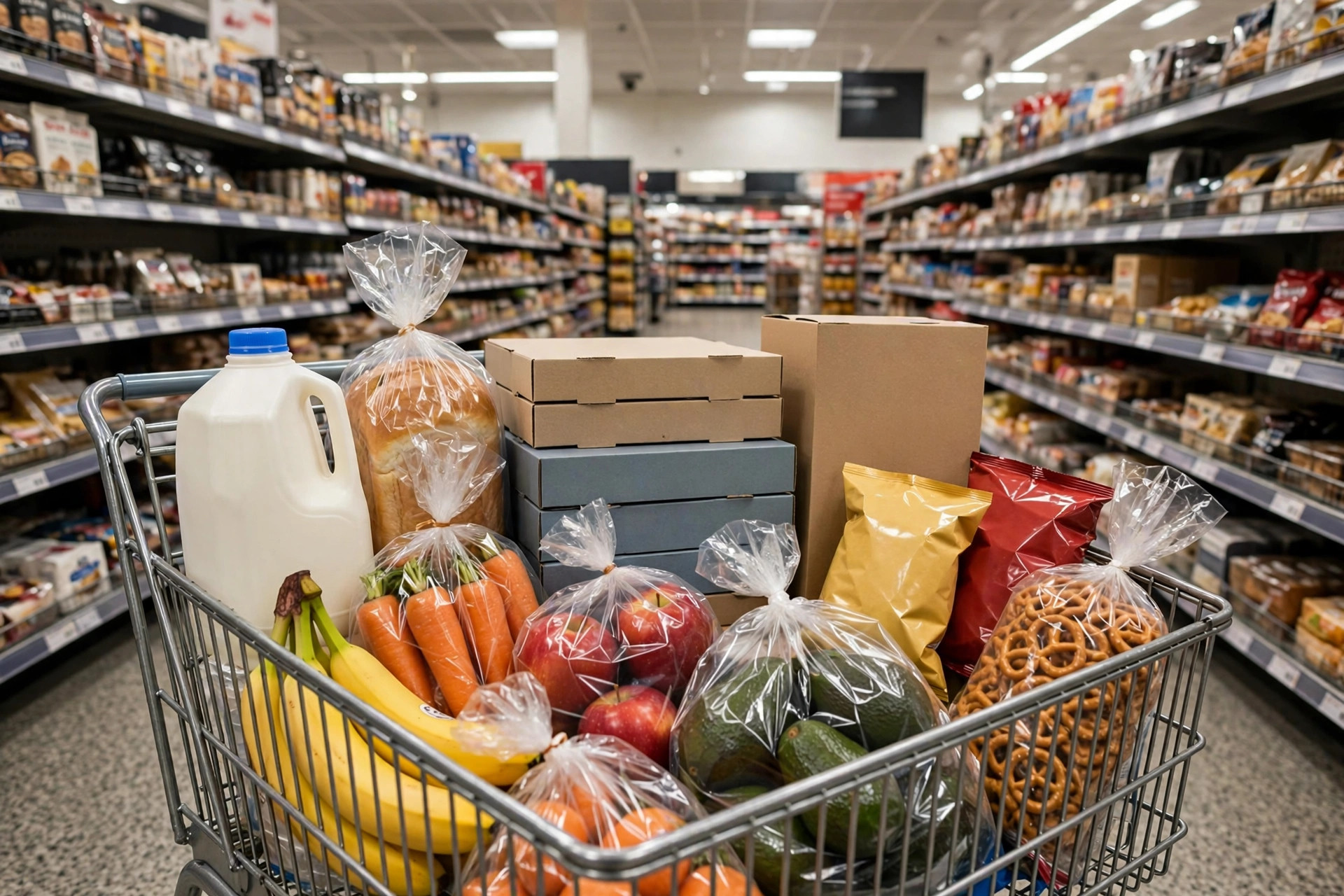
    Family grocery cart from Kroger weekly ad deals

    🚫 Skip these: 4 “deals” that aren’t deals

    1. Bud, Miller or Coors — $17.99 (filed under “This Week’s Best Deals”). The same brands are sitting in the liquor section at $12.99. That’s five dollars more for the “best deal” badge, with no pack size shown to justify it. Hard pass.
    2. Kroger 93% Lean Ground Beef — $6.99/lb. No “was” price anywhere. Six ninety-nine a pound isn’t a deal, it’s just expensive ground beef wearing a sale costume.
    3. Private Selection Angus Top Sirloin Steaks — $13.99/lb (filed under “some favorites remain undefeated”). No was-price, no discount, just a premium cut being premium. Not a sale. Next.
    4. Private Selection Wildflower Honey Ham — $10.99/lb. This one isn’t even in the weekly ad section — it’s under “NEW lower everyday prices.” A price cut is not a weekly deal, no matter how they shelve it.

    That’s this week’s list. I’ll be back next Wednesday when the new ad drops — same time, same chaos, new prices. If you grabbed any of these deals, tell me how your cart came out. I love a good receipt.

  • Grocery Shopping Tips for Moms That Actually Work

    Grocery Shopping Tips for Moms That Actually Work

    I do the grocery shopping in this house. Every week: the cart, the coupons, two kids, one list, and a husband who works full-time and fixes cars on his days off. So when I read that the average household is spending close to $700 a month on groceries — $677 a month in 2025, projected to hit about $694 a month in 2026 — I don’t need a spreadsheet to believe it. I can feel it in my receipt.

    Grocery prices are up 2.2% compared to a year ago, according to the August 2026 inflation numbers. And here’s the part that stings: grocery prices are still 29.4% higher than they were in March 2020. So yes, your cart is smaller than it used to be. Mine too.

    I’m not here to lecture you. I’m a mom who clips Kroger digital coupons in the parking lot and has strong opinions about which store-brand cheese is garbage. Here are the grocery shopping tips that actually moved my bill — and the honest truth about the ones that didn’t.

    1. Shop your own kitchen before you shop the store

    Before I write my list, I open the fridge, the freezer, and the pantry. Every time. Because the number of times I’ve bought a second jar of pasta sauce when I already had two is genuinely embarrassing.

    Experts say planning meals and making detailed lists can cut grocery spending by 20% or more. I haven’t tracked my own savings to the dollar, but I believe it — because my biggest grocery sin was never the big-ticket items. It was buying stuff I already owned.

    The move: check what you have, build four or five dinners around it, and only then make the list. The cheapest meal is the one already sitting in your cupboard.

    Mom checking her fridge and pantry before grocery shopping to save money

    2. Play store-brand roulette

    This one is the closest thing to free money in the whole grocery store. A Consumer Reports analysis found the average family can save about $5,000 a year by switching to store brands — with savings of 25 to 30% on standard grocery items like pasta, coffee, and orange juice.

    And it’s not “settling.” In blind taste tests, Kroger’s store-brand creamy ranch beat Hidden Valley — at roughly half the price per serving. Aldi’s condensed chicken noodle soup beat Campbell’s. The experts were surprised. I was not, because Kroger ranch is legitimately good and I’ll die on that hill.

    A separate study of 171 staple products at Kroger, Target, and Walmart found even bigger gaps on some items: store-brand sports drinks ran about 74% cheaper than the name brand at Walmart, fruity cereal nearly 70% cheaper, ketchup around 67% cheaper, and milk about 60% cheaper.

    My rule: buy the store brand once. If nobody in the house notices, it’s the new house brand. There are exactly two items where my family has vetoed the swap, and I respect it — loyalty has a price, and sometimes it’s fifty cents.

    3. Digital coupons are free money (for things you’d buy anyway)

    I do almost all my shopping at Kroger, and the digital coupons in the app have saved me more money this year than any other single habit. It’s not even close. You clip them once, they live on your loyalty card, and they come off at checkout like magic.

    The trap I fell into: buying things because I had a coupon for them. I once bought a brand of crackers I don’t even like because there was a 75-cent digital coupon. That’s not saving money. That’s the store telling me what to want. Now I only clip coupons for stuff that’s already on my list.

    If your store has an app with digital coupons and you’re not using it, you’re leaving money on the register. That’s the whole tip. (I track Kroger’s weekly deals every week for Pocket Change Mama — it’s practically a hobby at this point.)

    Store brand versus name brand groceries side by side comparison

    4. Read the little sticker, not the big number

    The unit price — that tiny “per oz” number under the big price — is the only number on the shelf that tells the truth. The family-size bag is not always cheaper per ounce. The “buy 5, save $5” display is not always a deal.

    I got burned on this with coffee. The bigger bag looked like the smart buy until I checked the per-ounce price and realized the smaller one was cheaper. I felt like a detective who’d cracked a case nobody cared about.

    Watch for shrinkflation too: same box, same price, less stuff inside. The sticker doesn’t lie, but the packaging absolutely does.

    5. One cheap dinner a week

    Here’s a number that got my attention: swapping out meat for just one dinner a week can save about $9 a week — roughly $470 a year. I read that and immediately thought of my kids, because one of mine is on the spectrum and “new food” is a whole event in our house.

    So I didn’t go meatless-Monday-purist about it. I did pancake night. Breakfast for dinner with store-brand mix and frozen berries costs almost nothing, and nobody complains. Spaghetti night, egg-fried rice night, grilled cheese and tomato soup night — these aren’t fancy, but they’re the weeks my bill stays where I want it.

    Start with one. Don’t announce it. Just serve pancakes on a Wednesday and watch what happens.

    Using digital coupons on a smartphone to save money on groceries

    6. Stop throwing money in the trash

    The average American family loses $1,500 a year to wasted food. I know exactly how, because I’ve done it: lettuce turned to slime, leftovers I forgot existed, the yogurt I was “definitely going to eat.”

    Two things fixed most of this for me. First, leftovers became planned meals instead of sad fridge surprises — tonight’s roasted chicken is tomorrow’s chicken wraps. Second, I stopped treating “best by” dates like they’re legally binding. Other than infant formula, those dates are unregulated guesses from the manufacturer. If the yogurt smells fine and it’s been refrigerated, it’s fine. My nose has never once steered me wrong.

    7. Buy produce in season, and make friends with the freezer aisle

    Buying berries in December is a luxury purchase and your receipt knows it. Seasonal produce is cheaper because it didn’t ride a truck for a thousand miles. (Fruits and vegetables actually got 0.4% cheaper in August — produce is the one category giving us a break right now.)

    And frozen produce? Studies confirm it’s just as nutritious as fresh, it’s cheaper, and it doesn’t turn to soup in your crisper drawer while you’re busy living your life. I keep frozen broccoli, peas, and berries stocked at all times. Fresh is for the stuff we eat this week; frozen is for everything else.

    Fresh seasonal produce and freezer storage for grocery savings

    8. Don’t fall for fake sales

    Stores are very good at making you feel like you’re saving money when you’re not. The “SALE” tag on a regular-priced item. The smaller package at the same price. The loyalty “deal” that’s still more expensive than the regular price at another store.

    Once I started paying attention to the actual price of my staples, I could spot real deals immediately. That’s the boring superpower: know your prices. Know what your milk costs, your eggs, your bread. Then a sale is a sale, and everything else is decoration.

    Real talk: not every tip here will fit your house. I haven’t tried every coupon app on earth, and I won’t pretend this list is the final word. But between store-brand swaps (worth thousands a year for the average family), digital coupons (free money), one cheap dinner a week (about $470 a year), and wasting less food ($1,500 a year going in the trash), there’s real money hiding in a normal grocery routine. You don’t need a new budget app. You need to shop like the receipt is watching. Because it is.

  • Are Paid Surveys Worth It? An Exhausted Mom’s Honest Answer

    Are Paid Surveys Worth It? An Exhausted Mom’s Honest Answer

    So can you actually make money taking surveys on your phone? I have spent months tapping through money apps while sitting on my couch after the kids are finally asleep, and I have thoughts. Lots of them. Most of them not flattering.

    Here’s the thing nobody on TikTok will tell you: paid surveys are real, the money is real, and it’s also ridiculously small. This is the article I wish someone had written for me before I downloaded five survey apps and lost an entire week of my life telling a yogurt company how I feel about Greek yogurt.

    The Short Answer: No, But Also Yes

    No, surveys will not pay your rent. They will not replace a job. They will not fund a vacation. If someone is selling you a course on “survey stacking” that promises hundreds a month, they are selling you as the product.

    But yes, legit survey sites exist, they do pay real money, and if you’re the kind of person who is going to stare at your phone for 45 minutes while your toddler watches the same episode of a show for the ninth time anyway — well, those 45 minutes could earn you a dollar or two instead of zero. That’s the entire value proposition. Welcome to Pocket Change Mama, where we call pocket change what it is.

    Exhausted mom answering paid surveys on her phone late at night

    The Math That Actually Matters

    Let’s talk hourly rates, because the per-survey numbers are designed to make you feel better than you should.

    On the general survey sites — Swagbucks, Survey Junkie, that crowd — you’re realistically looking at about $2 to $5 an hour. Casual users doing a survey here and there for an hour or two a week typically land somewhere around $5 to $20 a month. Even the “regular” crowd, the people checking daily across a couple of platforms for 3 to 5 hours a week, are mostly in the $30 to $80 a month range.

    Do the math on that. Five hours a week — twenty hours a month — for fifty bucks. That’s $2.50 an hour. My time in the grocery store checkout line with two kids is worth more than that out of pure spite.

    The one exception is Prolific, which runs academic and research studies instead of brand surveys. Researchers on Prolific are required to pay participants at least $8 an hour, and most studies land between $8 and $15 an hour. That’s not life-changing, but it’s actual human wages instead of beermoney. There’s a catch, of course. There’s always a catch. We’ll get there.

    Clock and coins showing the time versus money tradeoff of paid surveys

    The Disqualification Problem Nobody Warns You About

    Okay, deep breath. This is the part that actually makes you rage-quit, and it’s the single biggest reason surveys feel like a scam even when the site is totally legit.

    Here’s how it goes: you click a survey that promises $1.50 for 15 minutes. You answer eight minutes of questions — your age, your zip code, whether anyone in your household buys dog food, your innermost feelings about laundry detergent — and then the screen goes blank and says “Sorry, you don’t qualify for this survey.” No pay. No partial credit. Eight minutes of your life, gone, and the company keeps your answers.

    Some people report getting screened out of a big chunk of the surveys they attempt. It is not a bug. The company only wants specific demographics — men 18 to 24, homeowners in Florida, left-handed marathon runners — and you don’t find out you’re not it until you’ve already done half the work. It is, to put it politely, infuriating. To put it impolitely would require the asterisk key, and I’ll just say I nearly threw my f*cking phone across the living room the third time it happened to me.

    This is why the “hourly rate” of surveys is a lie. A $2 survey that takes 15 minutes is technically $8 an hour. A $2 survey that takes 15 minutes plus three disqualifications before it is roughly $0 an hour. Count the screening time or don’t count the money — pick one.

    Frustration of getting disqualified from a paid survey on a smartphone

    The Sites That Are Actually Legit (in 2026)

    Now for the useful part. These are the survey sites that are genuinely legitimate — real companies, real payouts, no sign-up fees. A rule of thumb from the FTC: a legit survey site will never ask you to pay to join. If one does, run.

    • Prolific. The standout. Academic and research studies paying a required minimum of $8 an hour, usually $8 to $15 an hour in practice, with a small PayPal cash-out minimum of around six bucks. The catch: you have to join a waitlist before you get access, and studies fill up fast, so there aren’t unlimited hours available. I haven’t personally gotten in yet, but every serious survey-taker I can find online says it’s the one worth waiting for.
    • Survey Junkie. The simplest option — nothing but surveys, no games, no nonsense. Most surveys pay $0.50 to $3, and you can cash out to PayPal or gift cards at just $5. Casual users typically earn $10 to $50 a month. The disqualification problem is real here, though, and it’s the top complaint across the board.
    • Branded Surveys. Similar deal — surveys paying $0.50 to $3, $5 cash-out minimum, PayPal payouts that usually land in 1 to 3 days. Has daily polls and loyalty streaks if you’re the type who shows up every day.
    • Swagbucks. The big one, around since 2008 and supposedly paid out over $700 million over the years. It’s not just surveys — there are games, shopping cashback, videos — and payouts start around $3 to $5. The upside is variety; the downside is that the disqualification complaints are loud and frequent.
    • AttaPoll. Mobile-first and simple: surveys from 20 cents for a one-minute poll up to around $10 for longer ones, with a low $3 cash-out to PayPal or gift cards. Good for the couch-scroll scenario.
    • Google Opinion Rewards. Not a money-maker, but worth a mention: Google occasionally sends you short surveys and pays small amounts in Play credit (or PayPal if you’re on iPhone). The surveys are quick and easy, but there just aren’t many of them.
    • InboxDollars. Legit — around since 2000, tens of millions paid out — but it has one of the higher cash-out thresholds of the bunch and a reputation for piddly earnings and heavy disqualifications. If you use it, know the cash-out minimum before you grind, so you’re not surprised at the finish line.

    The One I’d Actually Bother With

    Look, I keep it real on Pocket Change Mama, so here’s my honest take. If you only try one, make it Prolific. The hourly pay is in a different universe from the rest — $8 to $15 an hour versus $2 to $5 — because academic researchers have to pay a minimum rate instead of tossing you a buck fifty for twenty minutes of your life. Sign up for the waitlist and forget about it until they let you in.

    While you wait, Survey Junkie is the least annoying of the general sites: clean, no games pretending to be work, and the $5 cash-out means you actually see your money instead of grinding for weeks toward some unreachable threshold. That’s the trap to watch for on any site — a high cash-out minimum is how platforms get you to quit with $14 of earnings sitting in their account instead of yours. Cash out early and often.

    Shield with checkmark showing legit paid survey sites to trust

    If You Do This, Do It Like This

    I’m not going to pretend there’s a strategy that turns surveys into rent money. But if you’re doing it anyway, here’s how to waste the least of your time:

    1. Only do surveys during dead time. Waiting at a doctor’s office, half-watching a show you’ve already seen, sitting in the car during school pickup. The moment surveys eat into time you’d spend doing something better, you’ve lost.
    2. Skip anything over 15 minutes unless the pay is worth it. A survey paying $2 for 25 minutes is $4.80 an hour before disqualifications. You can do better doing literally nothing.
    3. Fill out your profile completely. It’s boring, but an incomplete profile means fewer invites and more disqualifications, which is the whole problem we’re trying to avoid.
    4. Make a separate email address. Survey sites will absolutely flood your inbox with offers. Keep it far away from your real email or you’ll start resenting your own notifications.
    5. Never lie to qualify. Tempting, I know. But survey platforms have consistency checks, and getting banned with your earnings still inside is worse than getting disqualified.
    6. Never pay to join anything. Legit survey sites are free. Always. Any site asking for a fee is a scam, full stop.
    Realistic morning routine doing paid surveys with coffee for small extra earnings

    So… Are Paid Surveys Worth It?

    For most people, honestly? Not really. The math is brutal, the disqualifications are enraging, and your time is probably worth more than $3 an hour even on a lazy Sunday.

    But here’s the thing — and this is why this blog exists. Some of us have pockets of dead time that are never going to become productive hours. I am never going to turn the twenty minutes I spend scrolling my phone while my son finishes his show into a freelance writing gig. That time is gone either way. A survey app that turns it into a couple of bucks a month — a coffee, a kid’s app download, a few dollars off the grocery bill — isn’t a scam. It’s just small.

    That’s the whole promise of Pocket Change Mama: not riches, not rent money, just honest little amounts that add up because broke moms don’t have the luxury of leaving money on the table, even when it’s only a couple of dollars at a time.

    So are paid surveys worth it? If you go in knowing exactly what they are — pocket change for dead time, with Prolific as the one genuinely decent earner — then yeah. Just don’t let anybody tell you they’re anything more than that.

  • 9 Frugal Mistakes That Cost You More Money (I Made Most of Them)

    9 Frugal Mistakes That Cost You More Money (I Made Most of Them)

    Cheap isn’t always frugal — and frugal isn’t always cheap

    Look, I get the impulse. Money is tight, everything costs a fortune, and the internet is full of people telling you to cut corners. So you cut one. And then that corner costs you double.

    I’ve done this. More than once. My husband does car repair side jobs, so our house is basically a museum of “we’ll just do it ourselves” projects that sat half-finished in the garage for six months. Being frugal is one of the whole reasons Pocket Change Mama exists — but there’s a difference between being smart with money and being cheap in a way that bites you in the ass later.

    Here are the frugal fails I keep seeing (and, yeah, several I’ve personally committed), plus what actually works instead.

    Hand putting cash into a white piggy bank, representing frugal habits that save money

    1. The $20 DIY that costs more than just buying the thing

    I saw a craft blogger make a cute little decor piece and thought, I’ll just make that myself. Forty-five minutes in the craft store later I’d spent $20 on supplies for something I could have bought for $30 at HomeGoods. Then I got home, botched it, and threw it in the trash. So now I’m out $20, three hours, and the $30 thing anyway.

    DIY only saves money if you’re already good at it and already own the tools. If you have to buy every supply and learn the skill and do the work, you didn’t save anything. You just bought yourself a stress project.

    Do this instead: Price the finished item first. Then price ALL the supplies honestly — glue gun, paint, the wood piece, the thing you always forget. If the DIY doesn’t beat the store price by a mile, just buy the store one and save your Saturday.

    DIY project gone wrong with crooked shelf and spilled paint, a frugal mistake that costs more

    2. Buying the cheapest version… and then buying it again

    There’s a whole corner of the internet dedicated to people who bought cheap shoes for jobs where they stand all day — then went through two cheap pairs and a pile of insoles while their feet still hurt. I haven’t bought those exact shoes, but I’ve lived the same lesson with kitchen stuff. The cheap can opener. The dollar-store broom. You know the one.

    “Buy cheap, buy twice” is the truest sentence in personal finance. The cheapest option isn’t frugal if it dies in three months and you have to replace it. It’s just expensive with extra steps.

    Do this instead: Think in cost-per-use. A $40 gadget you use every day for five years is cheaper than the $12 one you replace twice a year. For stuff you use constantly, buy the middle tier — not the fanciest, not the flimsiest.

    3. Driving across town to save 10 cents a gallon on gas

    Gas is cheaper on the other side of town, right? So you drive 15 minutes out of your way to save 10 cents a gallon. On a fill-up, that’s maybe a buck or two — and you just burned that exact amount of gas getting there and back. Congratulations, you did a whole errand to break even.

    It’s the same math for driving to three different stores to chase the lowest price on everything. Your time is worth something, and your car eats gas and wears down whether the errand was worth it or not.

    Do this instead: Fill up wherever you’re already going. Use your Kroger fuel points or a gas cash-back app on the station you pass anyway. Combine errands. The cheapest gas station is the one on your actual route.

    Worn out cheap shoes next to quality shoes showing buying cheap costs more over time

    4. The coupon stockpile that expires in your pantry

    I love a good digital coupon — I clip Kroger coupons every single week. But there’s a dark side, and it’s the stockpile. You get so excited about the deal that you buy four of something your family will never finish before it expires. Then you throw away three of them. You didn’t save 50%. You paid full price to make your pantry feel full.

    Same goes for the extreme couponing hours — clipping, organizing, driving store to store. If you spent two hours to save $4, that’s not a $4 win. That’s a part-time job paying $2 an hour.

    Do this instead: Clip coupons for stuff you already buy, and stockpile only things that don’t go bad. My rule: if it expires and we don’t use it weekly, I buy exactly one.

    5. Skipping car maintenance until it becomes a car repair

    This one hits home because my husband literally fixes cars. You skip the $40 oil change to save money, then six months later the engine sounds like it’s gargling gravel and the fix is ten times that. Brakes squeak? “It’s fine, it’s just squeaking.” It’s never just squeaking. It’s always the rotors too.

    Maintenance is one of those bills that feels optional right up until the moment it becomes an emergency. And emergencies don’t let you shop around.

    Do this instead: Put maintenance on the calendar like a bill. Oil changes, tire rotations, the dentist appointment you’re avoiding. Prevention is almost always cheaper than the repair. (I say this as someone who has learned it the annoying way.)

    Car driving a long road chasing cheap gas, a frugal mistake that wastes money

    6. Bulk-buying groceries that turn into science experiments

    Buying in bulk saves money if you use it. A family of four can demolish a big pack of chicken. But that giant bag of salad? That becomes a bag of green slime on day five and goes straight in the trash. And I am absolutely talking about myself here. The number of times I’ve bought the family-size produce “because it was a better deal” and then composted half of it is embarrassing.

    Wasted food is just groceries you paid to throw away. The unit price means nothing if half the units go in the bin.

    Do this instead: Bulk-buy only what your family actually finishes: frozen stuff, shelf-stable stuff, snacks the kids inhale. Perishables? Buy for the week you’re actually living, not the week you wish you were living.

    7. Signing up for free trials and forgetting to cancel

    “It’s free for 30 days!” Sure it is. Then day 31 shows up and you’ve been charged for a streaming service, a meal kit, and an app you opened twice. Free trials are designed around one simple fact: busy moms forget things. The companies are counting on it.

    This one’s not even about being cheap — it’s about a good intention getting hijacked by a calendar you never set.

    Do this instead: Cancel the trial the same day you sign up if they’ll let you keep the free days (most do). If not, set a phone reminder for two days before it ends. And once a month, scroll your bank statement for mystery charges. You’ll be horrified. It’s worth it.

    8. Cutting cable, then subscribing to everything

    “I’m not paying $100 a month for cable anymore!” Great. Then you get Netflix, Hulu, Disney+, and whatever else, and suddenly you’re paying more than the cable bill you were so mad about. I know families doing exactly this right now.

    Cutting the cord only works if you actually cut. Otherwise you just swapped one big bill for five medium ones.

    Do this instead: Pick the one or two you actually watch and rotate the rest. Watch everything you want on one service, cancel it, start the next. Nobody is watching five streaming services at once. Be honest about which ones are just sitting there.

    Overflowing pantry stockpile with coupons, buying in bulk gone wrong

    9. Buying stuff just because it’s on sale

    The clearance rack is a trap and we all know it. A shirt that’s 70% off still costs money if you never wear it. “But it was such a good deal!” A good deal on something you don’t need is just spending with a better excuse.

    Stores design sales to make you feel smart for buying. The discount is real, but so is the hole in your budget.

    Do this instead: The 24-hour rule. If you still want it tomorrow and it fits the budget, fine. But ask the real question first: would I buy this at full price? If the answer’s no, the sale isn’t saving you money — it’s costing you.

    The bottom line

    Being frugal isn’t about spending the least possible. It’s about spending on purpose. Every one of these mistakes has the same shape: I tried to save money without doing the math, and the math won.

    At Pocket Change Mama, I’m not going to pretend I have it all figured out. I’m going to tell you what actually worked, what blew up in my face, and what was a complete waste of my time — because that’s the stuff that actually helps. Cheap is easy. Smart is the whole game.

  • Here’s What $200 Gets You at Kroger This Week (Sept 16–22)

    Here’s What $200 Gets You at Kroger This Week (Sept 16–22)

    Okay, new series idea, and I’m genuinely excited about this one: every week I’m taking Kroger’s weekly ad and building a full $200 family grocery cart out of the actual deals in it. Not the fake ones. Not the “was $8.99, now $8.79, what a STEAL” nonsense. The real price drops, stacked with digital coupons, shopped the way Pocket Change Mama actually shops.

    This week’s ad runs Wednesday, September 16 through Tuesday, September 22, and I priced everything at my local Kroger. Your prices might wiggle a little depending on your store, but the ad items are the same, so this should get you close.

    Ground rules: every digital deal below is either already clipped in my Kroger account or one you need to clip before you go. Two of the best ones are pickup/delivery-only. And yes, I did all the math so you don’t have to. You’re welcome.

    Quick heads-up: Kroger sales and digital coupons can vary by location, so your prices might look a little different than mine. But this shopping list should definitely help get you started.

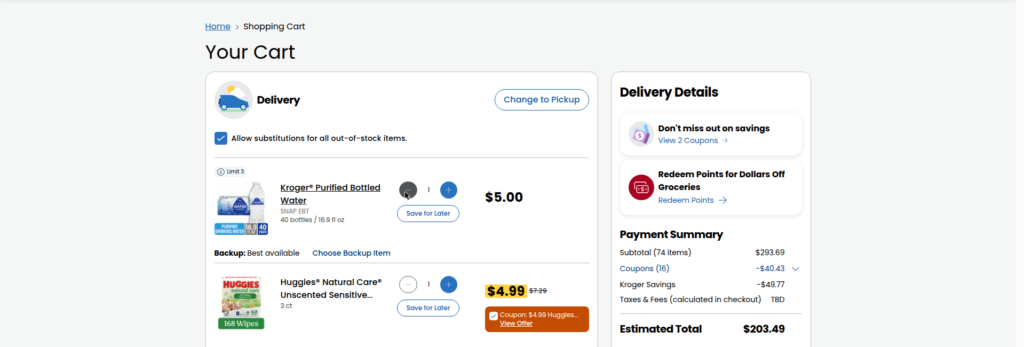
    Kroger shopping cart showing 74 items with an estimated total of $203.49 after coupons and savings
    The full cart: $203.49 at my local Kroger

    My handwritten math said $202.85 — Kroger rang it up at $203.49. Sixty-four cents of register math, I’ll take it.

    The Meat Haul

    🍗 Simple Truth Natural Boneless Chicken Breasts (~3 lb) — sale $3.99/lb, digital coupon takes $1.00/lb off (pickup/delivery only — clip it!) → final $2.99/lb = $8.97 · running total: $8.97

    🥩 3-lb Kroger Ground Beef — digital deal (clip it!) → $11.97 ($3.99/lb) · running total: $20.94

    🐷 Boneless Pork Half Loin or St. Louis Style Pork Ribs (~3 lb) — $1.99/lb → $5.97 · running total: $26.91

    🐟 Kroger Atlantic Salmon Fillet Portion — $12.00 · running total: $38.91

    🥓 Simple Truth Bacon — $5.00 · running total: $43.91

    🌭 Kroger Breakfast Sausage Links or Patties — $2.69 · running total: $46.60

    Kroger cart showing meat and pantry deals with digital coupon savings

    Dairy & Eggs

    🥚 18-ct Kroger Eggs, Grade A Large — $1.99. A dollar ninety-nine. For EIGHTEEN eggs. In this economy?? · running total: $48.59

    🧀 Tillamook Cheese — $2.49 · running total: $51.08

    ☕ Chobani Creamer — $3.99 · running total: $55.07

    🥛 Chobani Greek Yogurt × 2 — $2.99 each with the mix & match 5+ deal → $5.98 · running total: $61.05

    🧈 Challenge Butter — digital deal (clip it!) → $2.99 · running total: $64.04

    Produce

    🍑 California Yellow Peaches or Red/Black Plums (2 lb) — $1.99/lb → $3.98 · running total: $68.02

    🫐 Jumbo Blueberries — $4.99 · running total: $73.01

    🍎 Large Honeycrisp Apples (3 lb) — $2.49/lb → $7.47 · running total: $80.48

    🍓 Strawberries, 16 oz — digital deal (clip it!) → $1.99 · running total: $82.47

    🍇 California Seedless Grapes (2 lb) — $1.99/lb → $3.98 · running total: $86.45

    Kroger cart showing produce and pantry items with digital coupons applied

    🫐 Raspberries or Blackberries, 6 oz — $2.99 · running total: $89.44

    🥒 Cucumbers × 4 — 79¢ each → $3.16 · running total: $92.60

    🌽 Sweet Corn × 6 — 33¢ each → $1.98 · running total: $94.58

    🥗 Kroger Salad Kits — 3 for $10 → $10.00 · running total: $104.58

    Pantry & Snacks

    🧀 Cheez-It Family Size Crackers — $3.99 · running total: $108.57

    🥔 Party Size Lay’s, Kettle Cooked or Smartfood — digital deal (clip it!) → $3.49 · running total: $112.06

    🥣 Kellogg’s Cereal × 2 — digital deal $1.79 each (already clipped in my account) → $3.58. Bonus: I’ve also got a 50¢ Kellogg’s manufacturer coupon clipped — if it stacks, that’s $1.29 a box. · running total: $115.64

    🍫 Quaker Chewy Granola Bars × 2 — digital deal $1.49 each (clipped!) → $2.98 · running total: $118.62

    🍕 Red Baron Pizza × 2 — digital deal $3.49 each (clipped!) → $6.98 · running total: $125.60

    🥜 Jif Peanut Butter — digital deal $4.99 (clipped!) · running total: $130.59

    🍨 Ben & Jerry’s × 2 — digital deal (clip it!) $2.99 each → $5.98 · running total: $136.57

    🌭 Johnsonville Dinner Sausage — digital deal (clip it!) → $4.49 · running total: $141.06

    🍖 Sweet Baby Ray’s BBQ Sauce × 2 — $1.39 each with mix & match 5+ → $2.78 · running total: $143.84

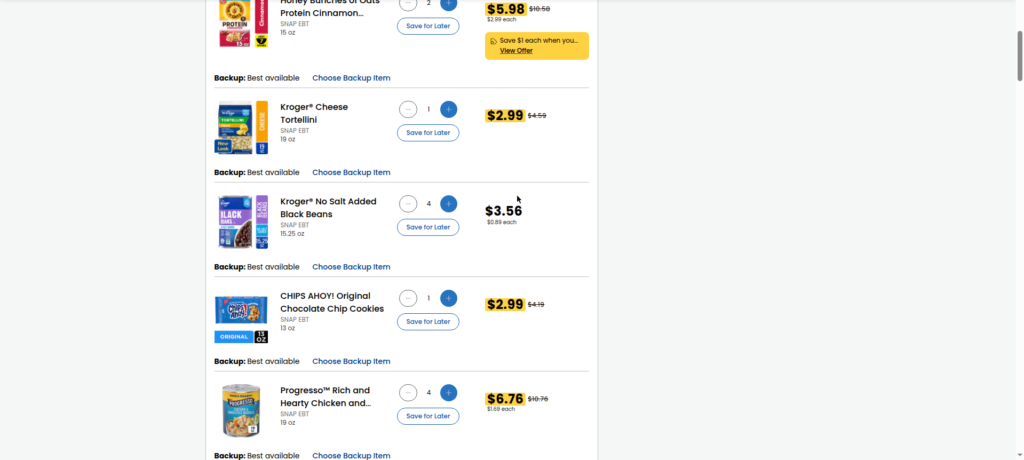
    🍲 Progresso Soup × 4 — $1.69 each → $6.76 · running total: $150.60

    🍪 Chips Ahoy Cookies — $2.99 · running total: $153.59

    Kroger cart showing pantry staples with sale prices

    🫘 Kroger Canned Beans × 4 — 89¢ each → $3.56 · running total: $157.15

    🍝 Kroger Frozen Pasta — $2.99 · running total: $160.14

    🥣 Post Large Size Cereal × 2 — $2.99 each with mix & match 5+ → $5.98 · running total: $166.12

    🍅 Heinz Ketchup — $3.49 with mix & match 5+ · running total: $169.61

    🍗 Tyson Frozen Chicken — $5.79 with mix & match 5+ · running total: $175.40

    🍗 Tyson Chicken — digital deal $7.99 (clipped!) · running total: $183.39

    Household

    🧺 Arm & Hammer Laundry Detergent — $3.49 · running total: $186.88

    🧴 Suave Shampoo or Conditioner — $1.99 · running total: $188.87

    🪥 Colgate Toothbrush or Toothpaste — digital deal (clip it!) → $3.99 · running total: $192.86

    👶 Huggies Wipes — digital deal (clip it!) → $4.99 · running total: $197.85

    💧 40-Pack Kroger Water — $5.00 · running total: $202.85

    The Damage: $202.85

    Two hundred and two dollars and eighty-five cents for a cart with salmon, Honeycrisps, Ben & Jerry’s, bacon, and a small mountain of produce. I’ll take it. That’s a legit week-plus of groceries for a family, plus household stuff, for about two hundred bucks.

    A few notes before you grab your keys:

    • The mix & match 5+ items (Chobani yogurt, Sweet Baby Ray’s, Post cereal, Heinz ketchup, Tyson frozen chicken) need at least 5 participating items in the cart to get those prices — and we’ve got 8, so we’re golden.
    • The digital deals marked “clip it!” weren’t clipped in my account when I checked — clip them in the Kroger app before you shop or they won’t come off at the register.
    • The chicken breast and ground beef deals are pickup/delivery-only, so plan accordingly.

    Skip These “Deals” 🚫

    Because Pocket Change Mama loves you enough to tell you the truth:

    🚫 Boneless Bottom Round Roast or Cubed Steak (USDA Choice) — $6.99/lb. It’s sitting in the “best deals” section like it owns the place. Seven bucks a pound for bottom round is not a steal, it’s a Tuesday. Wait until it drops under $5 and then we’ll talk.

    🚫 Private Selection Sparkling Mineral Water — $10.99. This is in the ad. That’s it. That’s the whole deal. A full-price bottle of fizzy water with a spotlight on it. Hard pass.

    🚫 Starbucks Coffee — $9.99 (with 5+ mix & match). Nine ninety-nine is what it costs when it’s NOT on sale. Putting it in a promo and calling it a deal is certainly a choice.

    🚫 Kroger Supplements, Buy 1 Get 1 Free. BOGO on vitamins in a grocery ad is the retail equivalent of a “you up?” text at 1am. Not groceries. Not a deal. Moving on.

    Related Reads 📚

    More money honesty from Pocket Change Mama:

    That’s week one of the $200 Kroger haul series. If you want me to keep doing these every week — and be honest, your grocery budget wants me to — let me know in the comments. And if you found a better deal in this week’s ad that I missed, drop it below. Pocket Change Mama never turns down a hot tip. 🧾

    Update

    I am not just doing this for show I am doing this to f*cking survive. I adjusted the list a bit to fit our budget and needs but I was still happy with what this list let me get.

    Kroger payment summary showing 32 items with $19.79 in digital coupons and $20.42 in Kroger savings, estimated total $80.45
    My real checkout: 32 items, $80.45 after coupons and Kroger savings.
  • What Is a Microearner? The Tiny Money Apps That Aren’t Side Hustles

    What Is a Microearner? The Tiny Money Apps That Aren’t Side Hustles

    If you Google “microearner,” don’t be surprised when Google basically looks back at you like, Ma’am, what the hell are you talking about?

    I made the term up.

    Not because I’m trying to invent the next obnoxious financial buzzword, but because I needed a way to describe a very specific cluster of money-making apps, and none of the usual terms really fit.

    They’re not side hustles. They’re definitely not jobs. Calling them “passive income” would be downright criminal.

    They’re microearners.

    And once you understand what I mean by that, you’ll understand why you’re going to see quite a few of them reviewed on Pocket Change Mama.

    So What Exactly Is a Microearner?

    A microearner is an app or platform that lets you exchange small amounts of time, attention, or activity for very small amounts of money, usually with a low cash-out threshold and relatively quick access to your earnings.

    Think:

    • Watching ads.
    • Playing ridiculously simple games.
    • Completing tiny tasks.
    • Answering short surveys.
    • Clicking through offers.
    • Doing something on your phone that earns you pennies at a time.

    And yes, I said pennies.

    We’re not pretending you’re going to download one of these apps tonight and wake up tomorrow with your electric bill covered.

    That’s the entire distinction.

    A traditional side hustle is something I’d evaluate based on whether the income is worth the time and whether it has potential to generate meaningful money.

    A microearner solves a different problem:

    I don’t have any money right now, and I need a few dollars.

    Sometimes $3 Is Actually Useful

    This is really why Pocket Change Mama exists.

    There have been times when I’ve paid the bills, bought the groceries, handled everything that needed handled… and then something happens.

    One of my kids wants a cheeseburger. We need some tiny thing I didn’t budget for. I need $3, $5 or maybe $10 right now, and the bank account has already thrown itself dramatically onto the fainting couch.

    That’s when earning advice like “Start a freelance business!” is spectacularly f*cking useless.

    I don’t need a five-year business plan.

    I need cheeseburger money.

    A microearner can sometimes solve that problem.

    Maybe I spend an hour mindlessly watching ads while I’m already sitting on the couch watching TV with my family. Maybe I bounce between a few different apps. Eventually I’ve got a couple dollars sitting in PayPal.

    Dead time, pocket change — earning microearnings on the couch

    Am I rich?

    Obviously not.

    Can I now use PayPal to place that food order?

    Yep.

    That’s the point.

    A Microearner Is NOT Replacement Income

    This distinction is important enough that I’m probably going to beat it to death across this entire website.

    Microearners are not replacement income.

    If an app earns me $2 an hour, I’m not going to tell you it’s an amazing opportunity and then multiply that by 40 hours to announce you can make $80 a week.

    Please don’t spend 40 hours doing that.

    These apps work best when the time you’re giving them wasn’t particularly valuable to begin with. I often mess with them while watching something with my husband or kids. I’m already sitting there. My brain is mostly elsewhere. I can tap a button, watch an ad, collect a reward and continue watching TV.

    That’s very different from giving up an hour I could have spent doing paid work for $2.

    Your earning rate can also change. Many microearners rely heavily on advertising, offers, or other systems that aren’t guaranteed to keep paying you at the same rate forever.

    Today’s $2.50/hour does not promise tomorrow’s $2.50/hour.

    What Makes a GOOD Microearner?

    Since I’m putting these apps into their own category, I’m also judging them differently.

    I don’t particularly care if a microearner has impressive monthly earning potential. That’s not its job.

    I care about things like how quickly I can reach the minimum withdrawal, whether I have to spend money first, how much attention it requires, whether the payout actually arrives, and how quickly I can access the money once I’ve earned it.

    An app that lets me earn $3 and cash it out immediately may be far more useful as a microearner than an app where I’ve technically “earned” $17 but can’t withdraw until I reach $50.

    Those aren’t earnings yet.

    They’re decorative numbers on a screen.

    Small earnings, real money — PayPal payout

    Pocket Change Mama wants the receipt, not the sales pitch.

    Related Reads 📚

    More tiny-money honesty:

    Why I’m Giving These Apps Their Own Name

    I needed microearner because “money-making app” is too broad and “side hustle” gives these things way too much credit.

    A microearner occupies this weird little financial junk drawer between doing nothing and actually working.

    You probably won’t build savings with one.

    You shouldn’t depend on one.

    And if you’ve got plenty of money available, most of them aren’t worth your time.

    But when you’ve got $0 and need $5, the math looks different.

    Sometimes you don’t need a new income stream.

    Sometimes you just need to turn an hour of otherwise useless scrolling into a burger, a gallon of milk, or one tiny emergency handled without pulling out a credit card.

    That’s a microearner.

    And those are exactly the little weirdos I’m going to test. 🧾💸

  • Jelly Drop Fusion Review: Does It Pay?

    Jelly Drop Fusion Review: Does It Pay?

    QUICK VERDICT

    Jelly Drop Fusion

    A terrible way to make meaningful money and a surprisingly useful way to make a tiny amount of money when a tiny amount of money is exactly what you need.

    SCORE
    7/10
    TESTED
    Jul 21 – Sep 19, 2026
    EARNED
    $0.36
    WITHDRAWALS
    6 (all paid)
    PAYOUT SPEED
    Seconds via PayPal
    MIN CASHOUT TESTED
    $0.01
    MONEY SPENT
    $0
    THE SCORECARD
    Earning potential 5/10
    Terrible as a job. Useful as a microearner.
    Effort required 9/10
    Close an ad, start another one. That’s it.
    Payout reliability 10/10
    Six withdrawals, all paid, almost instantly.
    Privacy & permissions 9/10
    No tracking required, no pile of personal info.
    WHAT WORKED
    • Extremely low cash-out amounts
    • Almost-instant PayPal payments
    • No money required to start
    • Basically zero mental effort
    WHAT DIDN’T
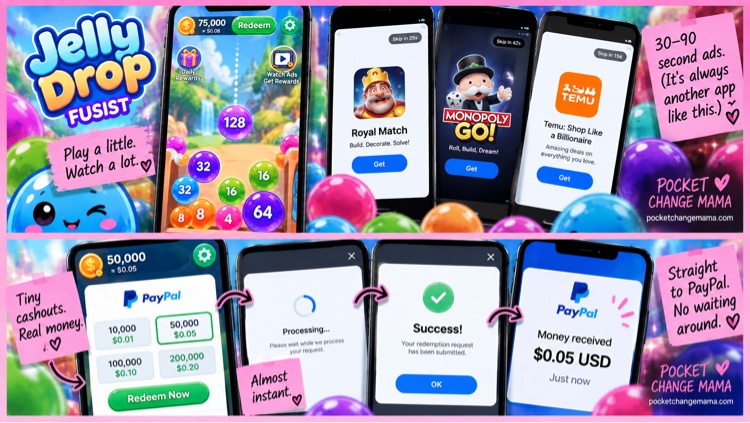
    • So. Many. Ads. (30–90 seconds, some unmutable)
    • An ad even plays after you cash out
    • The “game” is almost beside the point
    WHO IT’S FOR: Someone who needs a few dollars, has more time than money right now, and doesn’t mind running ads while watching TV.
    FINAL CALL: WORTH IT — as a microearner. Need more than ~$5? Look elsewhere.

    Related Reads 📚

    More tiny-money honesty:

    So… What the Hell Is a Microearner?

    Before we get into Jelly Drop Fusion, I need to explain how I’m judging this app, because otherwise we’re going to have the same dumb argument I have with my husband about whether a $2 scratch-off ticket is ‘basically free money.’ (It’s not, Greg.)

    I call apps like this microearners.

    They’re not side hustles. They’re not jobs. They’re not going to pay your rent, replace your paycheck, or fund the luxurious life some random TikTok creator is pretending to live because she has an affiliate link.

    They’re for those obnoxious little moments when you don’t need $500.

    You need $5.

    Maybe all your bills are paid, but your bank account is sitting there wheezing at $0 and your kid wants a cheeseburger and fries. Maybe you need a couple bucks for something stupidly small and don’t get paid until tomorrow.

    That’s where I think microearners have value.

    And Jelly Drop Fusion is one of them.

    Quick heads-up: the App Store lists this one as Jelly Drop Fusion, but once you’re actually playing, the loading screen calls it Jelly Drop Fusist. Same game, two names — don’t let it trip you up.

    Download Jelly Drop Fusion on the App Store

    I Have Actual Receipts, Not Just “Trust Me Bro”

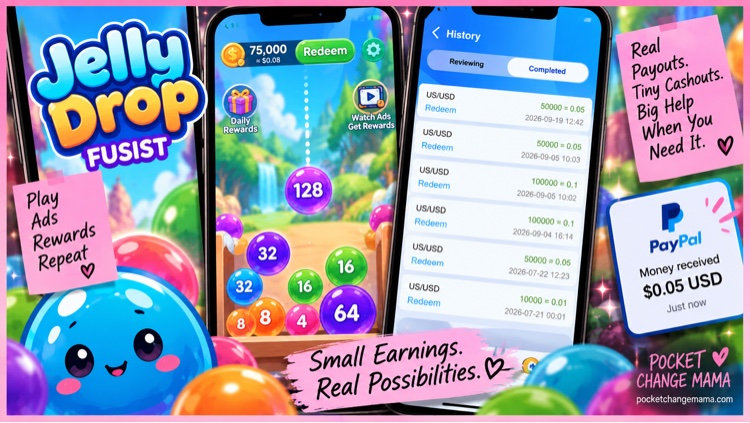
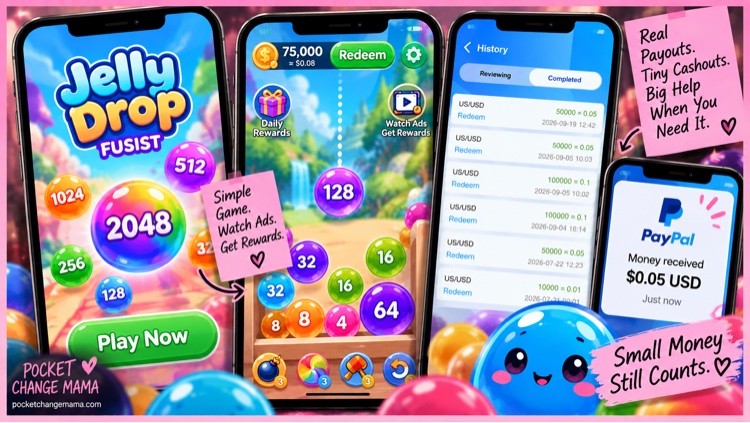
    I’ve had Jelly Drop Fusion on my phone since at least July 21, 2026, and I’ve cashed out six separate times. I’ve included screenshots of the app and my payment history below, including a $0.05 payment that landed in my PayPal account.

    My withdrawal history currently looks like this:

    DateAmount
    July 21$0.01
    July 22$0.05
    September 4$0.10
    September 5$0.10
    September 5$0.05
    September 19$0.05
    Total$0.36

    Yes, my first withdrawal was one entire American penny. 😂

    But honestly? I love that for testing purposes.

    I wasn’t willing to sit around earning $20 just to discover whether some random mobile game actually paid. The app let me request a microscopic withdrawal, so I did.

    And it paid.

    I’ve since cashed out five more times, and in my experience the PayPal payments have arrived within seconds.

    That’s one of the biggest reasons I’m willing to recommend this one for the very specific purpose I’m recommending it for.

    Jelly Drop Fusion gameplay, payout history, and a $0.05 PayPal payment

    The “Game” Is Basically Something to Do While You Watch Ads

    If you’re expecting me to review the riveting strategic gameplay of Jelly Drop Fusion, I have unfortunate news: this section is going to be very short.

    The game barely matters.

    You drop and combine little numbered balls. It’s colorful. It’s mindless. It gives your finger something to do.

    The ads are where the money comes from.

    You watch an ad, collect currency, close the ad, start another one, fiddle with the game for a minute, rinse and repeat.

    That’s basically the business arrangement here.

    You are not getting paid for your elite Jelly Dropping abilities. You are getting paid because somebody wants your eyeballs on an advertisement.

    And boy, do they want those eyeballs.

    Jelly Drop Fusion gameplay screen with daily rewards and payout history

    How Bad Are the Ads?

    They’re generally around 30–90 seconds, and this is easily the worst part of the app.

    Some of the longer ones can’t be muted. Some are advertising, rather hilariously, other apps that will pay you to watch ads.

    It’s the microearner circle of life. 🦁💸

    There’s also an ad after you cash out, which feels particularly rude.

    I have already sold you my attention. Please release my nickel.

    But this is also why I don’t usually sit down and think, Okay, time to work my Jelly Drop shift.

    I’ll mess with apps like this while I’m already watching something with my kids or husband. I’m not sacrificing productive work time. I’m mostly sacrificing the occasional few seconds required to close one ad and launch the next.

    That distinction matters.

    Jelly Drop Fusion ad screens and the PayPal cash-out flow showing a $0.05 payment

    My Latest Test: About 3 Minutes for $0.05

    For this review, I specifically tested another cash-out.

    I had 40,000 in-game currency already sitting in my account from previous play. I earned enough additional currency to reach 75,000, which the app displayed as approximately $0.08.

    That took me around three minutes, max.

    I then redeemed 50,000 for $0.05 through PayPal.

    The app deducted the currency, showed the successful withdrawal, and the payment notification arrived.

    Again, basically immediately.

    That’s exactly what I want from this category of app.

    But Please Don’t Do Terrible Math With That Three-Minute Test

    Here’s where I’m going to save us from the usual money-making-app nonsense.

    Five cents in three minutes does not mean I’m going to multiply that number out, slap an hourly rate on it and tell you Jelly Drop Fusion is your exciting new career opportunity.

    From actually using it, I think around $2–$2.50 an hour can be realistic for me when I’m actively earning.

    Even that should not be treated as a guaranteed rate.

    Ad-supported apps can change over time. The advertisements and rewards available to you aren’t necessarily going to remain identical forever, and long-term users may become less valuable from an advertising perspective. Your earning rate can slow down.

    So please don’t read $2.50/hour and calculate:

    “Sweet! I’ll play 40 hours and make $100!”

    No.

    Absolutely not. 😂

    That’s not what this app is for.

    So Why Would I Recommend Something That Pays So Little?

    Because sometimes $5 is $5.

    This is the part of making-money content that drives me insane.

    If you already have money, spending an hour or two watching advertisements to scrape together a few dollars sounds ridiculous.

    If you have literally no money, the equation changes.

    If my kid wants a burger and fries and I’ve got $0 available right now, but I can sit on my couch watching TV with my family, poke at my phone for a couple hours and end up with enough money in PayPal to order him something?

    Yeah.

    I’m going to take the damn $5.

    And because the money goes directly into PayPal, I don’t necessarily need to wait around transferring it to my bank before I can use it. For purchases where I can pay through PayPal, that removes another annoying barrier between earning the money and actually using it.

    That is the entire reason apps like this have a place on Pocket Change Mama.

    This Is Not Replacement Income

    I cannot emphasize this enough.

    Please do not download Jelly Drop Fusion because you need to make $100.

    If you need meaningful income, there are better uses of your time.

    If you need $20, I’d probably look elsewhere.

    If you need $2, $3, maybe $5, you’re broke at this exact moment, and you’ve got some dead time?

    Now we’re talking.

    You’re essentially trading attention and time for very small amounts of money.

    The trade sucks at scale.

    At tiny scale, it can be surprisingly useful.

    What I Really Like: The Cash-Out Minimum Is Tiny

    This might actually be my favorite thing about Jelly Drop Fusion.

    I’ve tested withdrawals as small as $0.01.

    A lot of reward apps will happily let you accumulate $3.72 and then inform you that you can’t have any of it until you’ve earned $10, $20 or some other arbitrary number.

    That makes them basically useless for the emergency-pocket-change scenario.

    Jelly Drop Fusion doesn’t have that problem in my experience.

    I’ve successfully withdrawn:

    $0.01.

    $0.05.

    $0.10.

    Multiple times.

    I would much rather have an app that reliably gives me my stupid little nickel than one displaying $37 of imaginary riches I can’t actually withdraw.

    Privacy Didn’t Give Me the Ick Either

    Another pleasant surprise: I don’t have to enable tracking to use it this way.

    That’s important to me because “we’ll give you twelve cents if you let us crawl inside your phone and establish permanent residency” isn’t exactly an enticing proposition.

    I haven’t needed to spend money, subscribe to anything, or enable tracking to earn and cash out.

    Obviously, you’re still using an ad-supported app and providing your PayPal account information when you request payment. I’m not declaring this some kind of privacy fortress.

    I’m saying that during my testing, it didn’t demand invasive permissions just to make a few cents.

    My Final Verdict

    Worth it, with a giant asterisk explaining what “worth it” means.

    Jelly Drop Fusion is not worth your time as a job.

    It’s not worth building an income plan around.

    It’s not something I’d recommend if you need more than about $5.

    But as a microearner?

    I’m keeping it.

    I’ve spent $0, successfully cashed out six times, received $0.36 total, and my payments have arrived through PayPal almost instantly. The earning requires practically no brainpower, and I can do it while I’m already sitting around watching something with my family.

    So if I’ve got money? I’m probably not touching it.

    If I’m staring at an empty account thinking, F*ck, I just need enough to buy my kid a cheeseburger?

    Yeah. I’ll watch some ads.

    That’s exactly what Pocket Change Mama is here for.

  • Hello world!

    Welcome to WordPress. This is your first post. Edit or delete it, then start writing!